
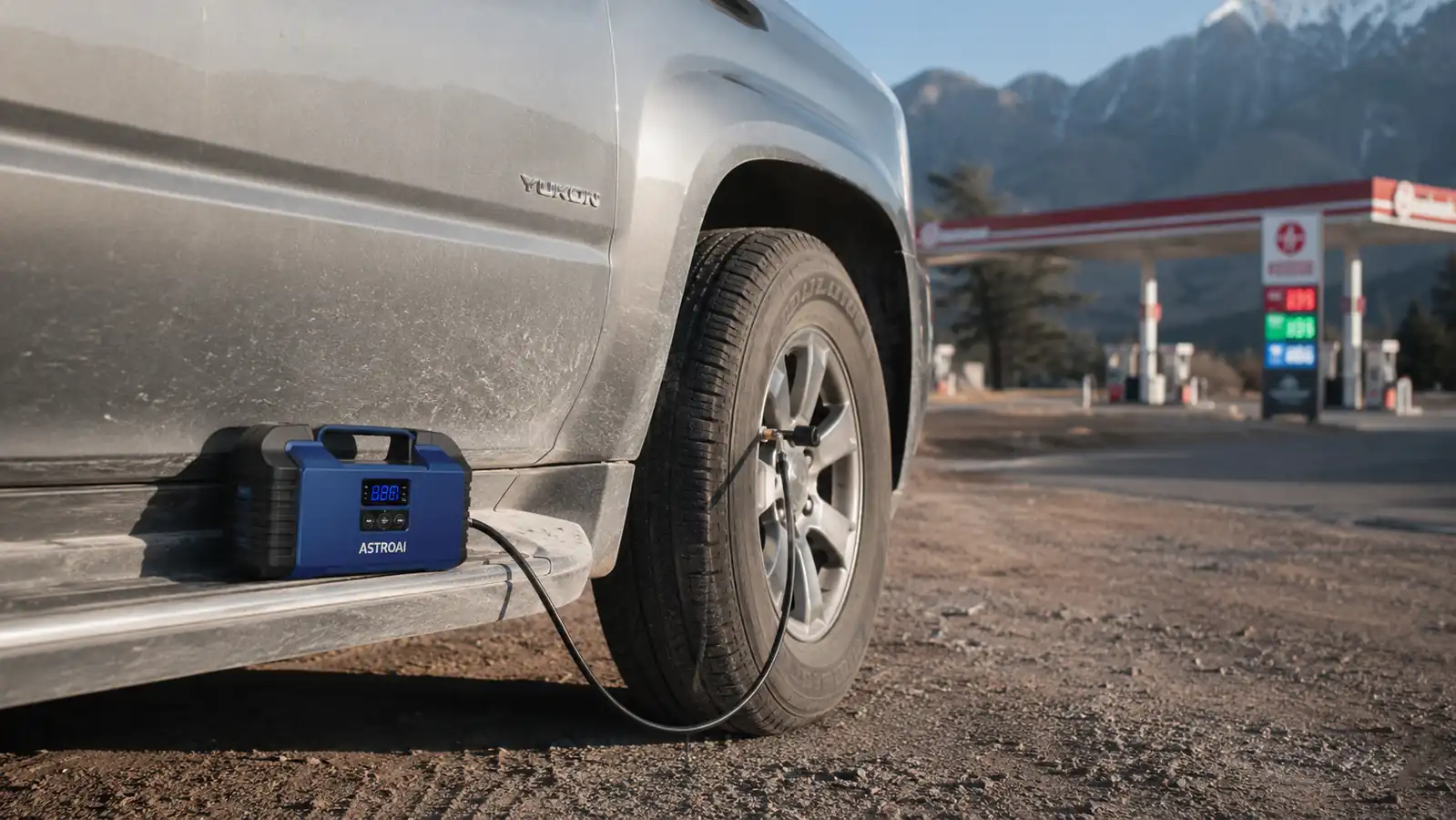
I bought the AstroAI 12V tire inflator a year ago after a slow leak in the front passenger tire of my 2018 4Runner turned a three-hour drive to McCall into a stop-every-90-minutes ordeal, because I had nothing in the truck to check pressure with, let alone add air. Since then it has ridden in the door pocket or the center console on every road trip my wife Rennie and I have taken, plus it has flown with us twice, checked in a duffel, to top off rental car tires before long drives out of airports in Denver and Reno. A year and roughly 9,000 miles later, I have a real answer on whether this budget inflator holds up, not a first-week impression.
This review covers what happened to the motor across dozens of full inflation cycles, whether the digital gauge stayed accurate against a separate reference gauge over twelve months, how the hose and fittings held up to being coiled and uncoiled in a truck console a hundred times, and how it behaved the two mornings I used it in genuinely cold weather. I am not going to pretend it is flawless. Some parts of it have earned real complaints.
The Quick Verdict
A reliable, accurate little inflator that has never left us stranded on low pressure, though the auto shut-off is inconsistent and the plastic tip connector shows real wear after a year.
Amazon Check Today's Price →Tired of Guessing at Tire Pressure Until the Low-Tire Light Comes On?
This inflator has topped off tires cold at dawn, in gas station parking lots, and at rental car curbs for a full year without the motor slowing down once.
Amazon Check Today's Price on Amazon →How I've Used It Over a Year
The inflator lives in the 4Runner's center console, cord coiled and tucked next to the hose, and it comes out roughly once a month even on a truck with no chronic leak, since Boise's temperature swings between winter and summer are big enough to move tire pressure several PSI on their own. It plugs into the 12V outlet on the dash and I run it off the truck's engine idling rather than the battery alone, which is the setup AstroAI recommends in the manual and the one I have stuck with the entire year.
Beyond routine checks, it has earned its keep on three real problems. It topped off that original slow leak in the passenger tire for two months before we got the tire patched. It re-inflated a tire that had dropped to 18 PSI overnight on a frozen morning outside Stanley in February. And it flew with us twice as checked luggage, once to air up a rental sedan's tires in Reno before a five-hour desert drive where the rental agency's own gauge read differently than what the door jamb placard called for.
I should say upfront that I always inflate to the number on the vehicle's own door-jamb placard, not the maximum PSI printed on the tire's sidewall. Those are two different numbers doing two different jobs, and mixing them up is a common and avoidable mistake. I also check pressure cold, meaning before the car has been driven more than a mile or sat in direct sun, since driving heats the air inside a tire and inflates the reading a few PSI higher than the tire's true resting pressure. None of what follows is professional mechanical advice, just what I have observed running this specific inflator against those two habits for a year.
Duty Cycle and Whether It Overheats on Multiple Tires
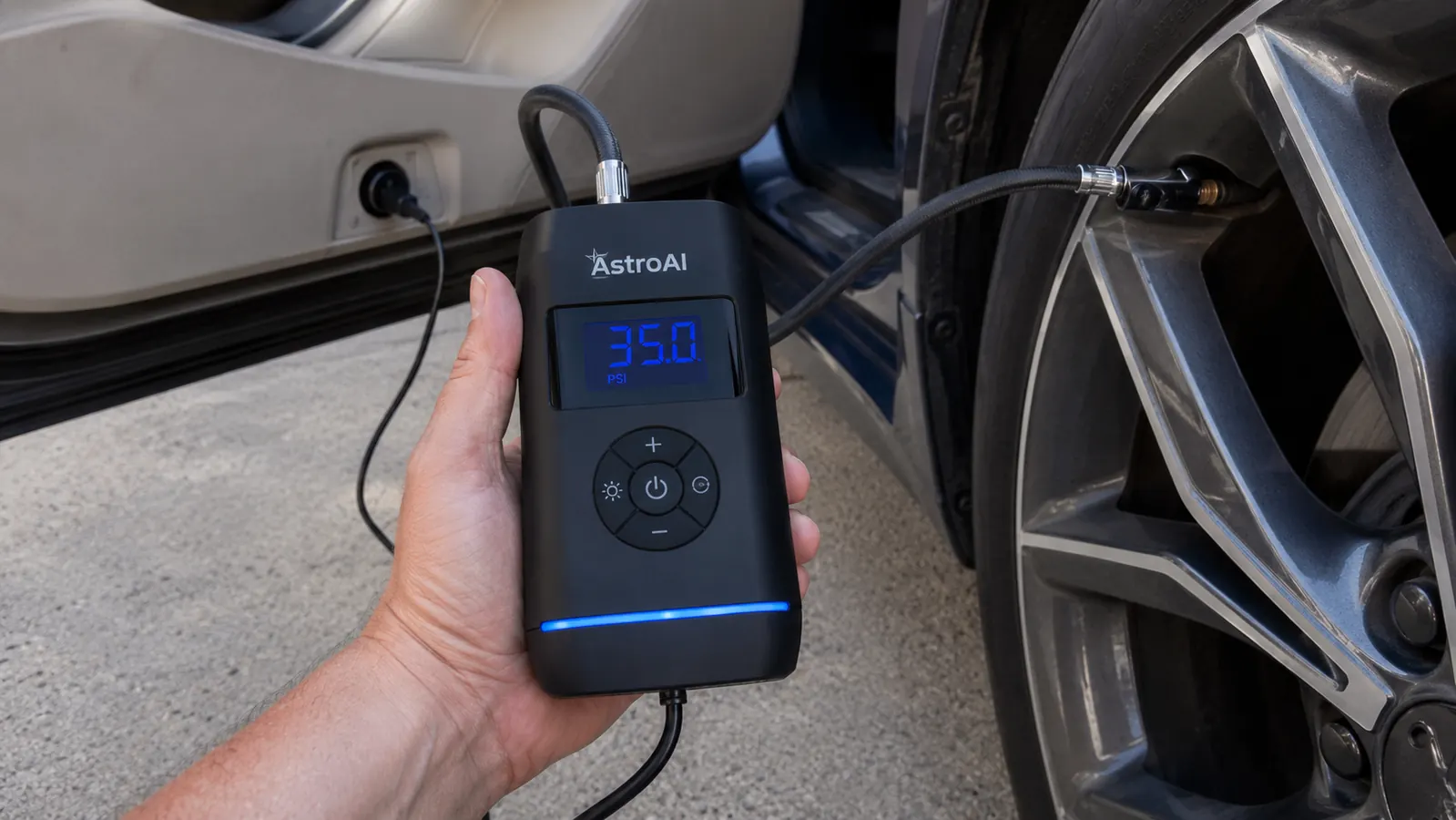
AstroAI does not advertise a continuous duty cycle number, and after a year of use I understand why the honest answer is complicated. Airing up a single tire from something like 24 PSI to 35 PSI takes this unit roughly two to three minutes depending on tire size, and it barely warms up doing that. The story changes when I air up all four tires back to back, which I have done maybe eight times over the year, usually after a seasonal pressure drop caught all four tires low at once. By the third tire, the motor housing is noticeably warm to the touch, and by the fourth I can hear a slight change in motor pitch that was not there on tire one.
I now build in a two to three minute rest between the third and fourth tire on an all-four job, mostly out of caution rather than because I have seen it fail. It has never shut itself off from heat or stopped working mid-job, but I would not run it continuously for ten or fifteen minutes straight on a hot afternoon without a break, and the manual itself suggests rest periods on extended use. On one 95-degree day in July, after four full tires plus a bicycle tire for a neighbor, I let it sit unplugged for five minutes before touching it again just because the housing felt like it deserved a break. That is the extent of the overheating story: real warmth on back-to-back jobs, no actual failure in a full year.
Gauge Accuracy Drift Against a Separate Reference Gauge
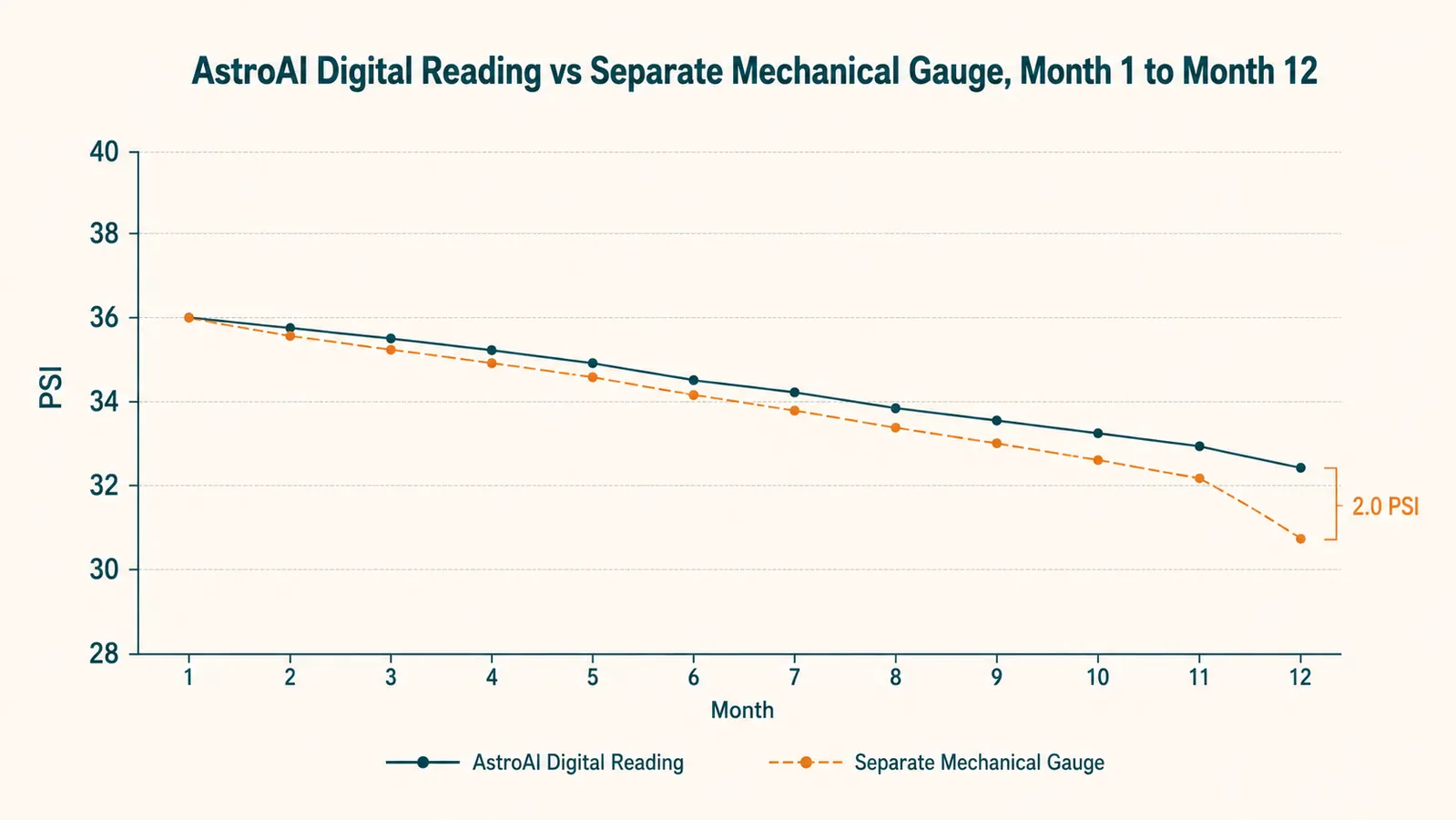
This was the question I cared about most going in, because a digital gauge that quietly drifts is worse than no gauge at all, it gives you false confidence. So a month into ownership I bought a separate analog pencil-style gauge just to check the AstroAI's digital reading against something independent, and I have compared the two roughly once a month since.
In month one, the two agreed within half a PSI on every tire I checked, which is about as close as you can expect two different gauge types to land. By month six, the AstroAI was reading consistently about 1 PSI higher than the analog gauge across all four tires, a small but real gap. By month twelve, that gap had widened to roughly 2 PSI on average, with the AstroAI still reading high. That is not a dramatic failure, and 2 PSI will not blow out a tire, but it is a real drift and it means I now mentally subtract 2 PSI from whatever the AstroAI displays before deciding if I am at my door-jamb target. I would recommend anyone using this inflator past the one-year mark do the same spot check against a cheap separate gauge rather than trusting the digital display blindly forever.
Hose and Fitting Durability
The rubber hose itself has held up better than I expected. It is maybe 8 inches long, short enough that I always end up positioning the whole unit close to the valve stem rather than relying on hose length, and after a year of coiling and uncoiling from the truck console, it shows no cracks and still flexes the way it did new. The brass valve connector at the end of the hose is the one part that has genuinely worn. The threaded collar that screws onto the valve stem has developed a slightly gritty feel when I turn it, likely from a year of dust and grit in a truck console, and it takes a couple extra turns now to get a fully airtight seal compared to when it was new. It still seals fine every time, it just asks a little more patience than it used to.
The main power cord, which runs about 9.8 feet from the 12V plug to the unit, has held up with no fraying, though the plastic sheath near the 12V plug end shows some wear from being wound tightly around the unit for storage every time. I have started coiling it looser specifically to avoid stressing that spot further. For anyone weighing this against just using a gas station air pump instead, our side-by-side breakdown of the AstroAI inflator against a gas station pump covers the tradeoffs in more depth than I can fit here.
Cold-Weather Behavior
Idaho winters gave me two real cold-weather tests. The first was that February morning outside Stanley, with the outside temperature sitting around 12 degrees Fahrenheit. The inflator started up without hesitation, though the digital display took noticeably longer to stabilize on a final reading, several extra seconds compared to how it behaves at room temperature. The motor itself ran fine and brought the tire up to target pressure in about the same time as a mild-weather job.
The second test was a frosty dawn start in a hotel parking lot outside Jackson, single digits overnight, car and inflator both left in an unheated trunk. The unit was stiff to the touch and the auto shut-off, which I will get to below, did not trigger at the set PSI that morning, forcing me to watch the display and stop manually. Everything worked once it warmed up over the first minute of use, but cold starts are clearly not this inflator's best moment, and I would not count on the auto shut-off in genuinely freezing conditions.

Where It Falls Short
The auto shut-off feature, which is supposed to stop the motor once the display hits your programmed target PSI, has worked reliably maybe eight times out of ten over the year. The other times it has run a couple seconds past target, or in that one cold Jackson morning, not triggered at all. I have learned to treat it as a convenience rather than something to walk away from, and I still watch the display on every fill. The LED work light built into the housing is dim enough that I mostly use my phone flashlight instead when airing up a tire in the dark, so I would not count that feature as a real selling point. And as covered above, the gauge accuracy drift and the gritty valve threading are the two things a year of use has genuinely worn down rather than just cosmetic scuffs.
None of these are dealbreakers on their own, but stacked together they are the honest reason this sits at a 4-star rating rather than a 5. It has never failed to inflate a tire when I needed it to, which is the core job, but it has stopped being the precise, hands-off tool it was on day one.
What I Liked
- Never failed to fully inflate a tire in a year of use, including two cold-weather starts
- Rubber hose shows no cracking after a year of coiling in a truck console
- Fast enough to top off a single tire in two to three minutes
- Small and light enough to fly with as checked luggage twice with no damage
- Handled a slow leak reliably for two months before the tire got patched
Where It Falls Short
- Digital gauge now reads about 2 PSI high compared to a separate analog gauge after a year
- Auto shut-off missed its target PSI roughly two times out of ten, including once in freezing weather
- Brass valve connector threading feels gritty and takes extra turns to seal after a year of dust exposure
- Motor housing runs noticeably warm on back-to-back four-tire jobs
- Built-in LED work light is too dim to rely on in the dark
By month twelve the gauge was reading two pounds high, close enough to fool you and far enough to matter if you never check it against anything else.
Who This Is For
If you drive long distances between fuel stops, or you fly and rent cars often enough that you cannot count on a gas station air pump being nearby or working, this inflator earns its spot in the door pocket. It has saved us from two genuinely inconvenient situations in a year, and the fact that it still works reliably after 9,000 miles of intermittent use says more than any first-week review could. For readers who want the fuller case for carrying one at all, our list of reasons to carry a tire inflator on road trips goes beyond just this one product.
Who Should Skip It
If your driving is mostly short local trips where a gas station pump is never more than a few minutes away, and you are not the type to check pressure proactively, you may never get enough use out of this to justify the space it takes in a glovebox. I would also skip it if you need something to trust blindly without ever cross-checking a reading, since a year of real use showed a real, if small, gauge drift. Pair it with a cheap separate gauge and check pressure cold against your door-jamb placard number, and it earns its keep. Skip that habit and you are trusting a display that has already proven it drifts over time.
A Year In, It Has Never Once Failed to Get Us Back on the Road
No stranded low-tire mornings, no hunting for a working gas station pump, no guessing at pressure before a long drive. If you put real miles behind the wheel, this small inflator has earned its place in the door pocket.
Amazon Check Today's Price on Amazon →