
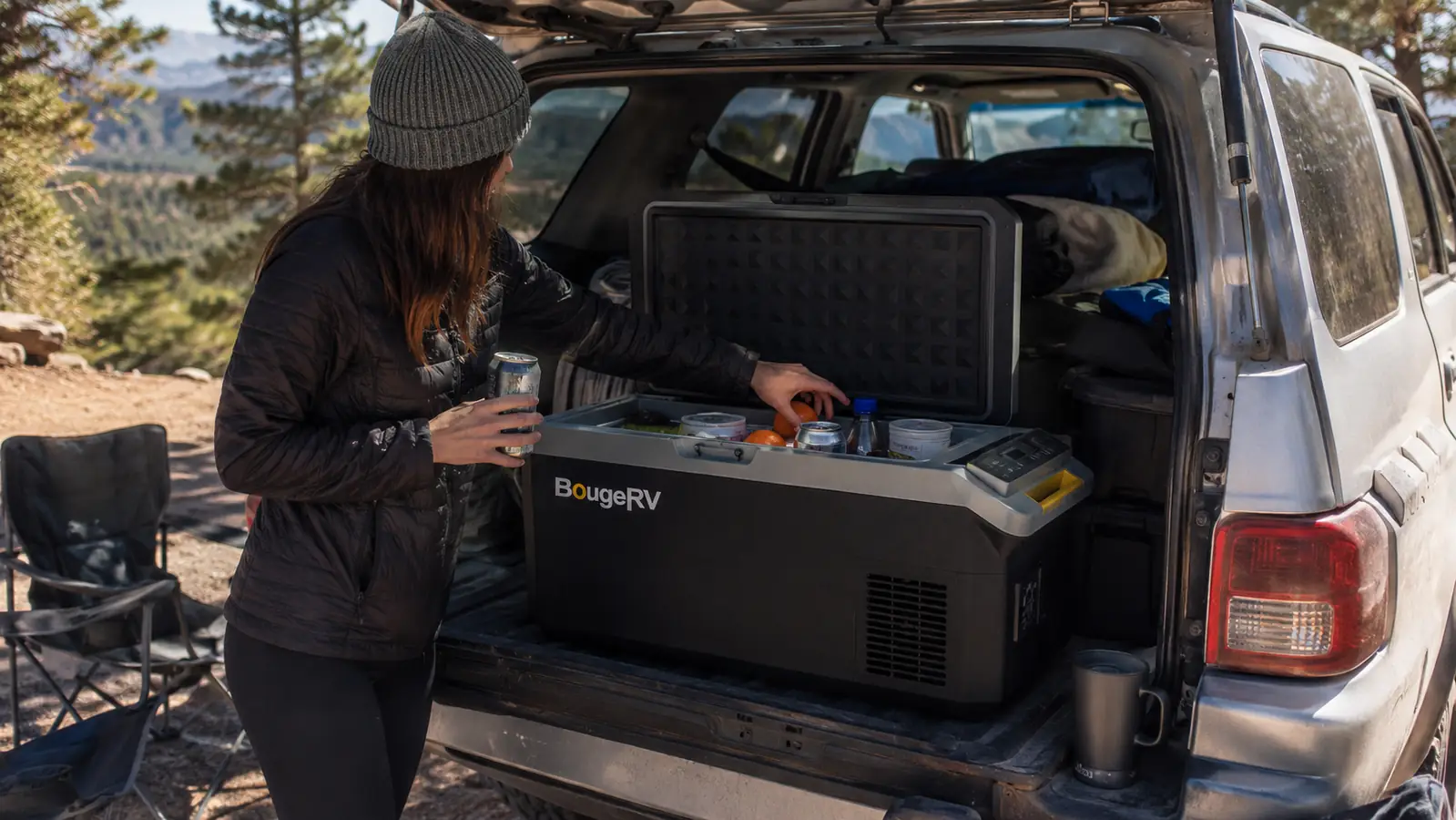
The BougeRV 23-quart 12V fridge has ridden in the back of my 2018 4Runner for six months now, strapped down behind the rear seats on every trip my wife Rennie and I have taken since late January, from a three-day run up to Bend, Oregon to a nine-day loop through Glacier National Park in June. I bought it to replace a cheap thermoelectric cooler that never got groceries below 45 degrees no matter how long the truck ran, and I wanted a straight answer on whether a compressor fridge was worth the extra weight and the extra pull on the truck's electrical system. Six months and roughly 4,200 miles later, I have that answer. I had gone through two coolers and one thermoelectric plug-in unit before this one, and I was done buying anything on a marketing promise alone.
This is not a first-impressions review written after one weekend. I have run this fridge through a cold Boise winter, a 104-degree afternoon on a gravel road outside Moab, and enough washboard forest service roads to shake loose anything that was not built right. What follows is what actually happened to the compressor, the battery drain, the latches, and the door gasket over that stretch, not what the spec sheet promises.
The Quick Verdict
A genuinely capable compressor fridge that has earned its permanent spot in the 4Runner, though the companion app is unnecessary and the DC power cord is the one part I'd want BougeRV to rebuild.
Amazon Check Today's Price →Tired of Warm Sandwiches and a Cooler Full of Melted Ice by Day Two?
This fridge has held a steady 34 to 36 degrees for six straight months without ice, without hauling water out the drain plug at a gas station, and without a single spoiled grocery run.
Amazon Check Today's Price on Amazon →How I've Used It Over Six Months
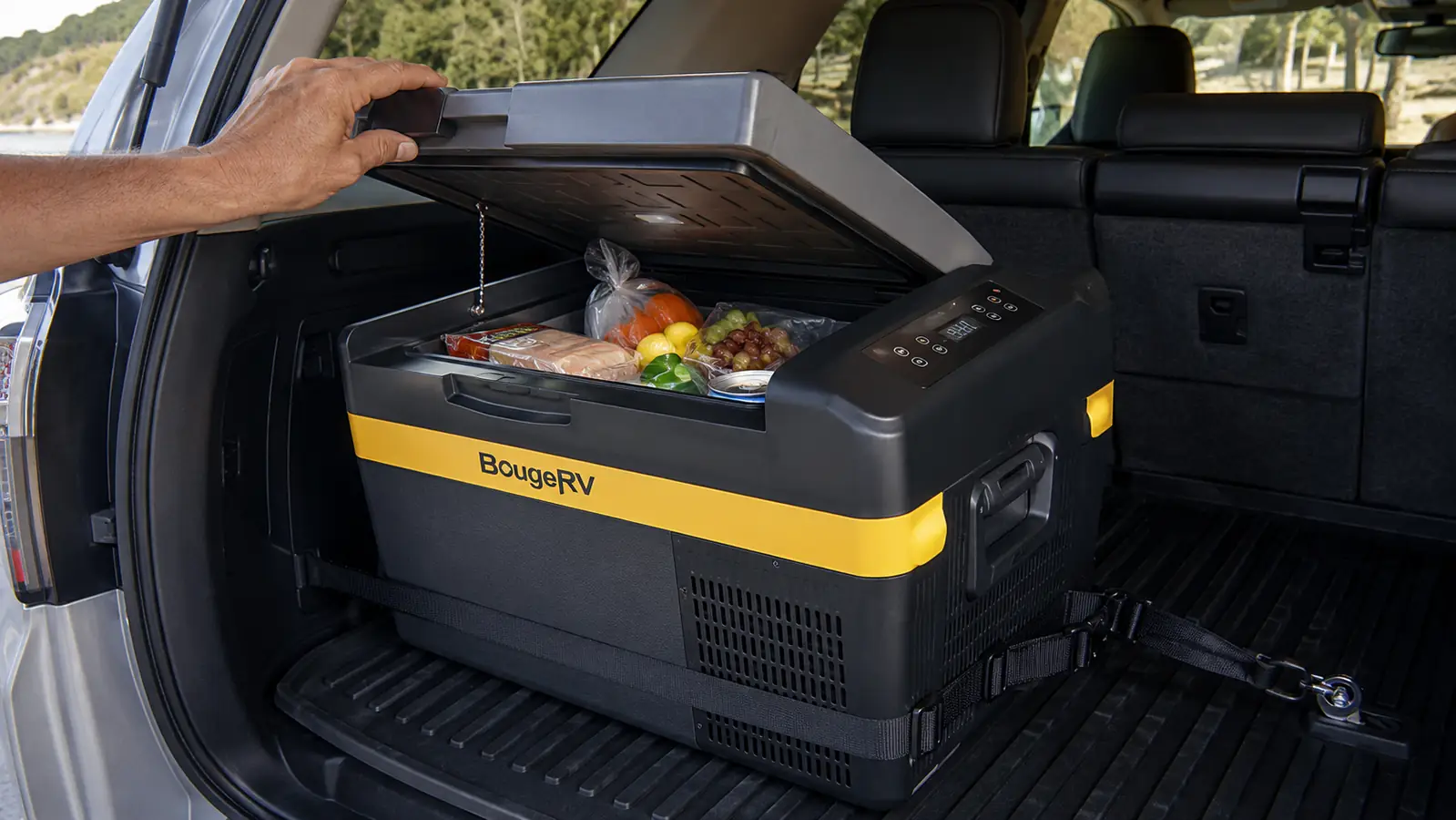
I set the fridge in the cargo area of the 4Runner with the seats folded flat and ran a cargo strap through the built-in tie-down loops on the base so it could not slide during hard braking or on rutted roads. That setup has not changed since the first trip. On road trips it stays plugged into a 12V outlet run off a small dual-battery setup I added specifically for this purpose. At home between trips, it sits on a shelf in the garage running off the included AC adapter, stocked with cold brew concentrate and whatever needs to stay cold for the next departure.
We have taken it on nine trips since January, ranging from an overnight in the Sawtooths to the nine-day Glacier loop. On the longer trips it holds a full week of groceries for two people, meaning I am not stopping for ice or a grocery run until day six or seven. On shorter weekend trips it mostly carries drinks, deli meat, and whatever produce Rennie packs, and it has never once let anything spoil in that role.
I also flew with it once, checked as luggage in a padded duffel to a rental cabin in Montana where I knew I'd need reliable cold storage for a week without a real kitchen. It survived baggage handling with no cracks in the lid and no dents in the corners, which told me more about the plastic housing than any spec sheet did.
Setting up the second battery took me an afternoon and cost more than I expected going in, and I'll admit I almost returned the fridge before I ever installed it, thinking the whole project was more truck work than I wanted to take on for a cooler upgrade. I'm glad I didn't. Once the isolator was wired in, the fridge became something I stopped thinking about entirely, which is the whole point of gear like this.
Cooling Speed and Actual Temperatures
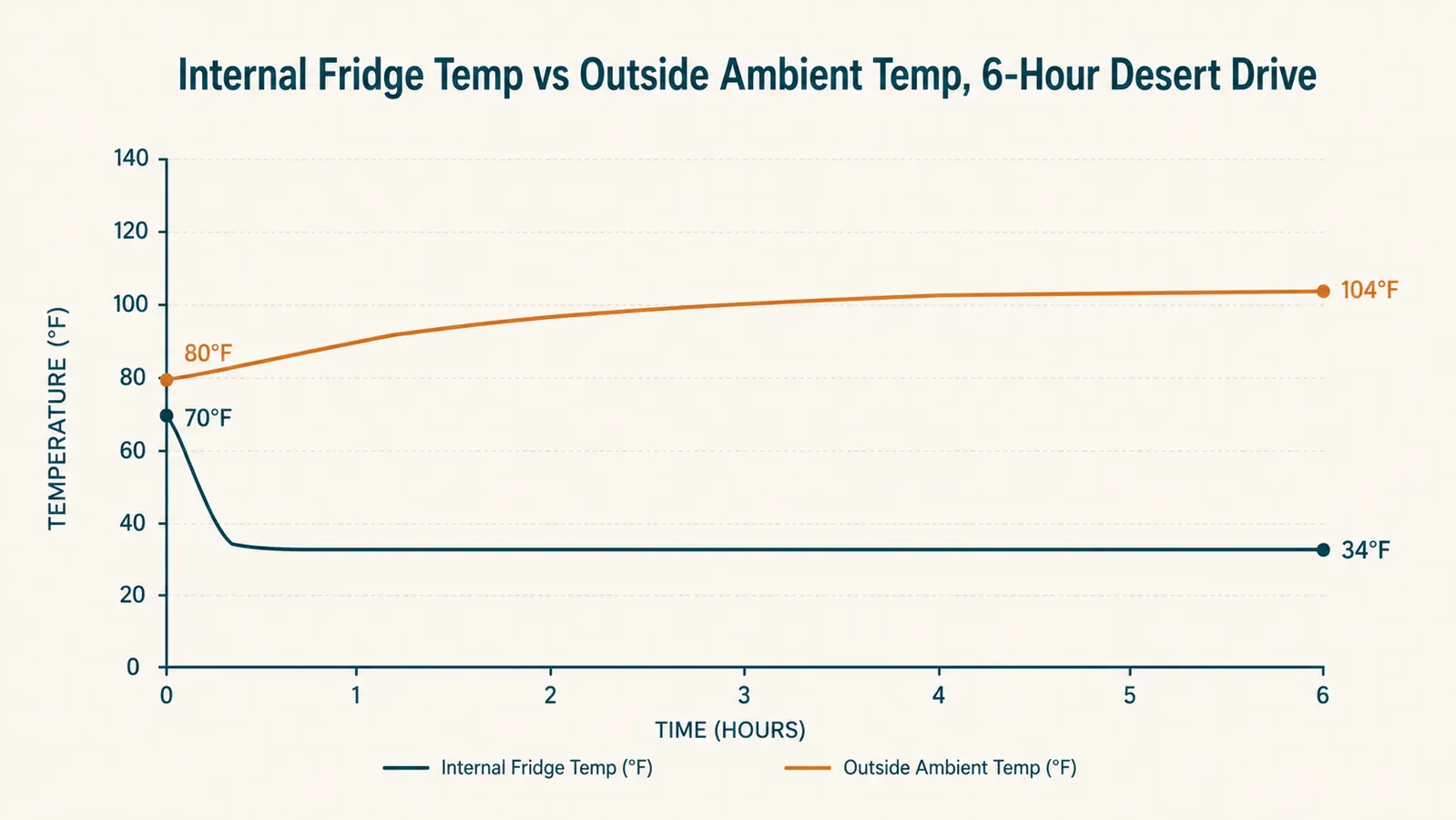
BougeRV advertises a 15-minute cool-down to 32 degrees, and in my own test, starting from a warm 82-degree fridge interior on a 90-degree afternoon in the driveway, it hit 34 degrees in 14 minutes and settled at 32 by the 20-minute mark. That is close enough to the claim that I stopped doubting it. On the desert drive outside Moab, with the outside ambient temperature climbing to 104 degrees by early afternoon, the internal temperature never moved off 34 degrees. The compressor just cycled harder and more often, which I could hear as a low hum through the back seats.
The temperature range on this unit runs from negative 8 degrees up to 50 degrees, so it doubles as a hard freezer if you want it to. I ran it at 10 degrees for four days on the Glacier trip to keep a stock of frozen elk sausage solid, and it held that setting without drifting, even parked in full sun for two afternoons while we hiked. The digital display reads out to the degree, and I never caught it lying to me when I checked contents against a separate probe thermometer.
Noise is worth mentioning since we sleep in the truck bed on some trips. At a normal cooling cycle the compressor sits around what I'd estimate is 43 to 46 decibels, closer to a running laptop fan than a generator. It is audible in a quiet campsite but has never kept either of us awake.
Running It Off the Truck Without Killing the Battery
This is where a compressor fridge separates itself from a cooler, and also where it can bite you if you are not set up for it. On startup the fridge pulls close to 60 watts, then settles to somewhere between 30 and 45 watts during normal cycling depending on ambient heat. Run straight off a stock starter battery with no isolator, I drained the 4Runner's battery to the point the truck would not start after about 14 hours parked with the engine off, which happened to me exactly once, on our first trip in February, in a gas station parking lot in Twin Falls at 6 a.m.
After that I installed a basic battery isolator with a second deep-cycle battery in the cargo area, which is the setup I'd now tell anyone to budget for before the fridge itself. Since making that change, the fridge has never once affected the truck's ability to start, even after three full days parked at a trailhead. On trips where I don't want to touch the truck's electrical system at all, I run it off a 300-watt portable power station instead, which keeps it going for roughly 20 hours on a full charge at moderate ambient temperatures. The fridge also has a low-voltage cutoff with adjustable sensitivity, so it will shut itself off before it does real damage to a battery if you forget to check it.
Build Quality After Six Months of Washboard Roads
The plastic housing has taken real abuse and shows it only as light scuffing on the bottom corners, no cracks or stress marks anywhere. The rubber door gasket still seals tight, and I have not had to reset or adjust it once. The two latches on the lid are the one part I'd flag. They still hold, but after six months of opening and closing them a dozen times a day on trips, the right-side latch has developed a slight wobble that was not there when the fridge was new. It has not failed, but I check it before every long drive now out of habit. The interior liner, which is a single molded piece rather than a separate insert, has not picked up a single stain or crack despite six months of raw meat, spilled milk, and melted popsicles, and it wipes clean with a damp rag in under a minute.
The wheels and retractable handle, which I use to pull the fridge out of the cargo area at camp, have held up better than I expected given how much gravel and dirt they roll through. One wheel picked up a small chip in the plastic rim from a sharp rock outside Moab, but it still spins freely and has not affected how the fridge moves.
What 23 Quarts Actually Holds
On paper 23 quarts sounds small next to a big cooler, but in practice it holds a genuinely useful amount for two people. A typical loadout for us on a week-long trip is a gallon of milk, a dozen eggs, two pounds of ground meat, a block of cheese, a half dozen yogurt cups, a bag of baby carrots, two bell peppers, a stick of butter, and eight cans of sparkling water, and there is still a little room left over for leftovers. It will not hold a week of groceries for a family of four, and I would not try to stretch it that far, but for the way Rennie and I actually eat on the road it has been the right size every time. Switch it into freezer mode instead of fridge mode and the usable space drops a bit further, since frozen goods don't pack as tight against the curved interior walls as cold drinks do, so I plan for that difference before a trip where I need both modes at once.

Where It Falls Short
Nothing about this fridge is perfect, and six months of daily use has surfaced a few real complaints. The included DC power cord is thinner than it should be for something that carries this much current, and I have already replaced the connector once after the original started feeling loose in the port. BougeRV's companion app, which is supposed to let you monitor temperature and adjust settings from a phone, has disconnected on me more than it has worked, and I stopped opening it after the second month. The fridge itself weighs close to 30 pounds empty, which is not heavy for a compressor fridge in this class, but it is enough that lifting it in and out of the cargo area solo, especially once it is loaded, is not something I love doing at the end of a long drive. I also noticed that opening the lid fully, rather than the smaller basket-access approach some drawer fridges use, lets more cold air escape each time, so on hot days I've learned to grab everything I need in one motion instead of standing there deciding.
Price is another honest tradeoff. This fridge sits well above what you'd pay for a basic hard cooler and above most electric cooler alternatives too, landing in a mid-range bracket for true compressor units. It is not the cheapest way to keep food cold on the road, and anyone weighing that decision should read our side-by-side breakdown of the BougeRV fridge against a standard cooler box before deciding which fits their actual trip pattern and budget.
What I Liked
- Hit 32 to 34 degrees in under 20 minutes even on a 90-degree afternoon
- Held temperature through a 104-degree desert drive without drifting
- Compressor noise stays around 43 to 46 decibels, quiet enough to sleep near
- Low-voltage cutoff protected the truck battery after I added a proper isolator
- Plastic housing shows no cracks or stress marks after 4,200 miles
Where It Falls Short
- Will drain a stock starter battery in about 14 hours without a battery isolator or power station
- Right-side latch has developed a slight wobble after six months of daily use
- Companion app disconnects often and adds little over the built-in digital display
- Included DC power cord felt loose at the connector after a few months
- At close to 30 pounds empty, loading and unloading solo gets old on long trips
The morning I nearly stranded us in a Twin Falls parking lot taught me more about running a compressor fridge than any spec sheet could.
Who This Is For
If you take trips longer than a weekend, especially ones where you are not passing a grocery store every day, this fridge earns its space and its weight. It has changed how Rennie and I plan meals on the road since we no longer build every trip around finding ice. Anyone comparing this to other cold-storage options for road trips should look at our full rundown of reasons a 12V fridge makes sense for road trips, which covers the broader case beyond just this one unit.
Who Should Skip It
If your trips are mostly single overnights, or you are not willing to add a battery isolator or carry a power station, this fridge will frustrate you more than it helps. A well-built cooler with good ice retention will do the job for a weekend without asking anything of your vehicle's electrical system, and it costs less up front. I'd also skip it if you need to feed more than two people for a full week, since 23 quarts runs out of room faster than you'd expect once you factor in drinks.
Six Months In, It's Still Earning Its Spot in the Cargo Area
No spoiled groceries, no ice runs, no drained cooler water pooling in the trunk. If your road trips run longer than a weekend, this is the upgrade that actually holds up.
Amazon Check Today's Price on Amazon →