
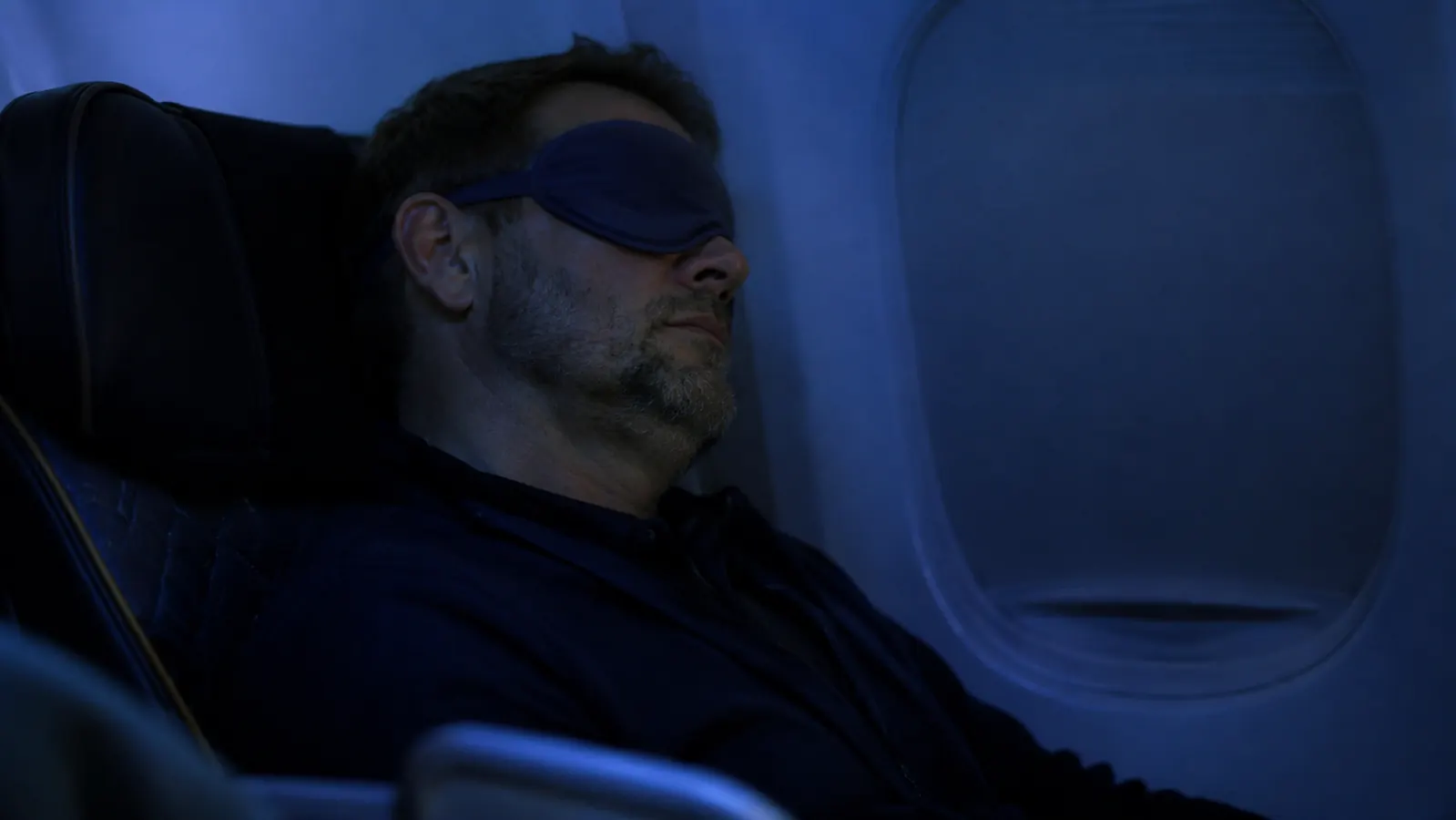
I used to think I just wasn't a person who could sleep on planes. Rennie can be out cold before we're through 10,000 feet, and I'd sit next to her wide awake somewhere over Nebraska, watching the little airplane icon crawl across the seatback map on a flight out of Boise. That changed once I stopped trying to force sleep and started fixing the seat instead. The turning point for me was the Angemay Airplane Foot Rest, a memory foam foot hammock that straps to the tray table arm. It sounds like a small thing. It wasn't, because it fixed the actual problem: in a 17-inch-wide economy seat, my knees had nowhere to go, and every time my legs went numb I'd wake back up.
This is a comfort guide, not a medical one. If you have a history of circulation issues, blood clots, or any condition your doctor has flagged around long flights, talk to them before you fly, and follow whatever they tell you over anything written here. What follows is what has actually worked for me on flights ranging from three hours to eleven, in five steps, roughly in the order I do them.
The seat isn't the problem. What you do with the 17 inches you're given is.
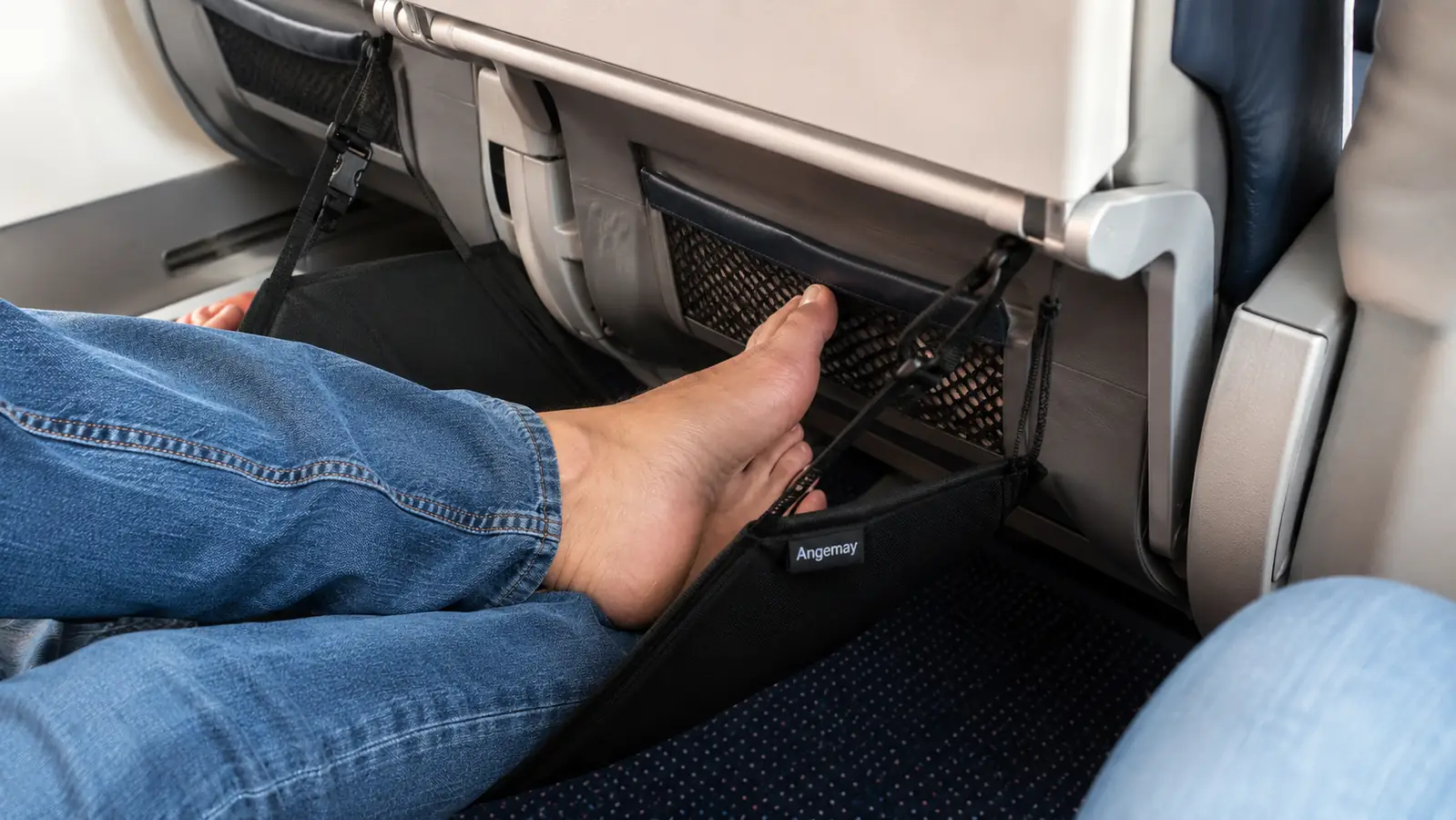
The Angemay Foot Rest is the one piece of gear that changed how I fly economy. It's a memory foam sling that straps to your tray table and gives your knees somewhere to actually rest instead of jamming into the seatback in front of you.
Amazon Check Today's Price on Amazon →Step 1: Pick Your Seat Before You Pick Anything Else
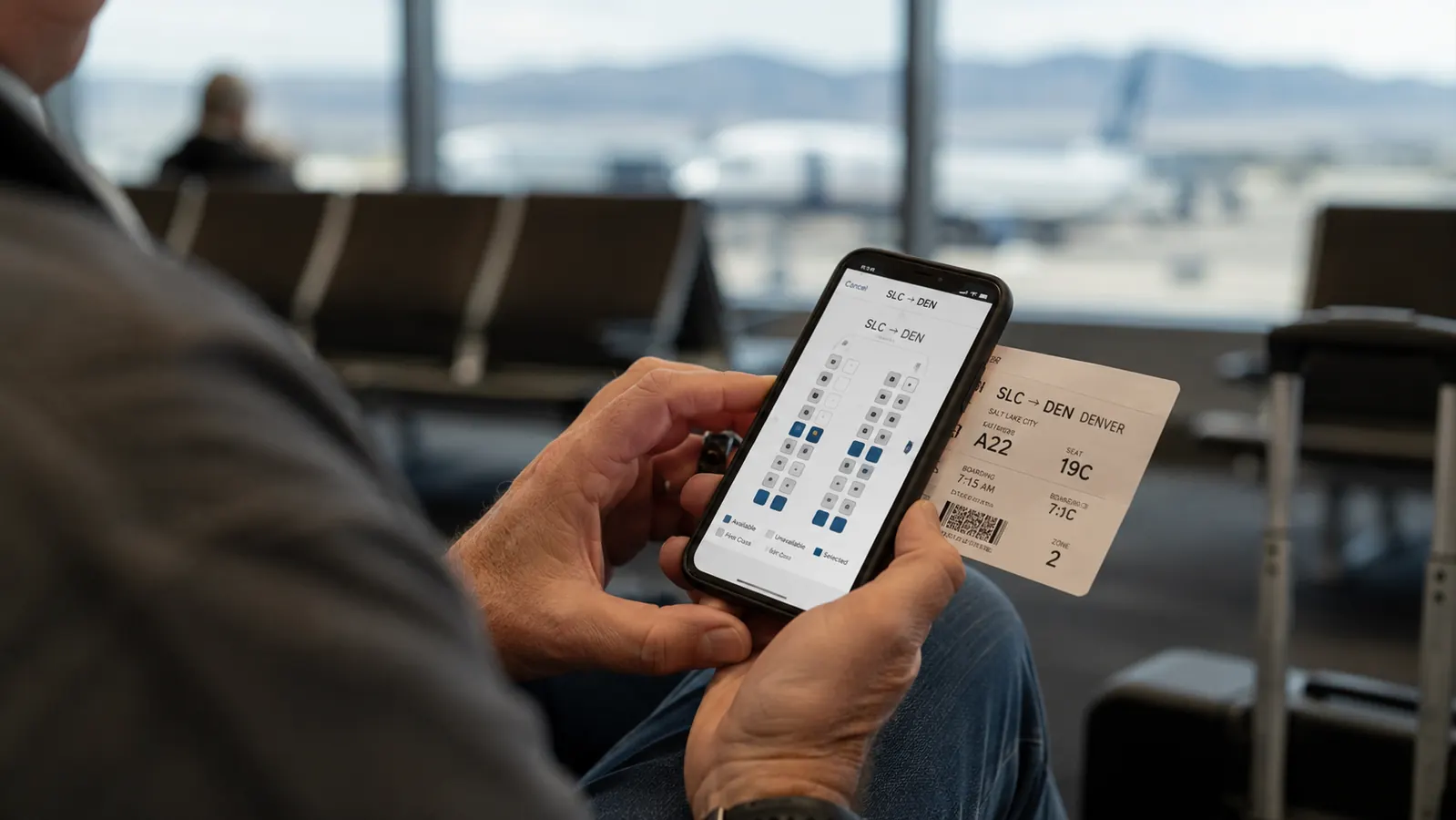
None of the rest of this matters much if you're stuck in a middle seat in the last row by the galley. Before I even think about gear, I look at the seat map. On flights over four hours I want a window seat if I'm actually planning to sleep, because you control the shade and you've got something to lean against. Aisle seats are better if you know you'll need to get up, which I'll get to in Step 5, but for straight sleep, window wins for me every time. I also cross-reference the seat map against a third-party seating guide before I book, since those sites will flag a specific seat as having a slanted wall, a misaligned window, or reduced recline that the airline's own map won't mention.
Bulkhead and exit rows sound like a win because of the legroom, but I've learned to check twice. Bulkhead rows often have zero underseat storage, which means your bag goes in the overhead and you can't get to anything mid-flight, and the tray table sometimes folds out of the armrest instead of the seatback, which changes how gear like a foot hammock attaches. I always check the seat diagram in the airline's app, not just the generic map, before I book.
I also avoid seats near the rear galley and lavatories now. I learned this the hard way on a flight from Boise to Chicago where I had a great reclining seat two rows in front of the aft galley, and the cart traffic and cabin crew conversation never really stopped for five hours. A row or two further forward, away from any galley, has made a bigger difference for me than almost any product I've tried.
Step 2: Build a Light and Noise Barrier Before You Try to Sleep
I put my eye mask and earplugs on well before I'm actually trying to fall asleep, usually as soon as the meal service or first beverage round is done. Waiting until you're already tired and frustrated to block things out means you're fighting an uphill battle. A contoured eye mask that doesn't press on your eyelids matters more than a cheap one that looks the same in a photo. I went through two flat foam masks that flattened out after a few folds in a suitcase before I found one with a real molded shape that holds up.
For noise, I use foam earplugs on shorter flights and noise-canceling headphones on anything over five hours, mostly because the headphones also let me play low ambient sound if the cabin is loud. Either way, the goal is the same: get the engine drone and the seatback video screens down to background noise before your brain starts negotiating with you about whether you're actually tired.
Dim your own screen too. I used to sit there scrolling with my phone at full brightness trying to "wind down," which is backwards. Now I turn the brightness down to the lowest usable setting and set myself a hard stop, usually right after the seatbelt sign goes off for the second time, cabin lights are dimmed, and it's actually dark enough to try.
Step 3: Give Your Legs Somewhere to Go
This is where the foot hammock earns its spot in my carry-on. Economy seat pitch on most domestic routes I fly out of Boise runs around 30 to 31 inches, and at just under six feet tall, that leaves my knees pressed against the seatback in front of me the second I try to sit up straight, let alone recline for sleep. The Angemay Foot Rest straps around the tray table arm and hangs a memory foam sling below it, so instead of my feet sitting flat on the floor with my knees bent at an uncomfortable angle, they're elevated and supported at roughly seat height. That one change took pressure off my knees and lower back in a way I didn't expect from something this simple.
A few practical notes from actually using it. It straps on with adjustable webbing, so it fits most tray table arms, but I always test the fit before I settle in, because a loose strap means the hammock sags and you end up readjusting it twice an hour instead of sleeping. Airline and crew policies on attaching anything to the tray table arm vary by carrier and can change, and some flight attendants are stricter than others about it during meal service or turbulence, so I ask before I use it rather than assume. On the two flights where a crew member asked me to unclip it for service, it took about ten seconds to remove and reattach, so it wasn't a big deal either way.
I wrote up the full six-month test, including how the foam held up after repeated packing and unpacking, in my long-term Angemay footrest review. If you're deciding between this style and the more basic strap hammocks sold alongside it, I also broke down the real differences in Angemay footrest versus the basic concepts hammock, since they look nearly identical in photos but aren't.
Step 4: Time Your Sleep Window to the Destination, Not Your Body
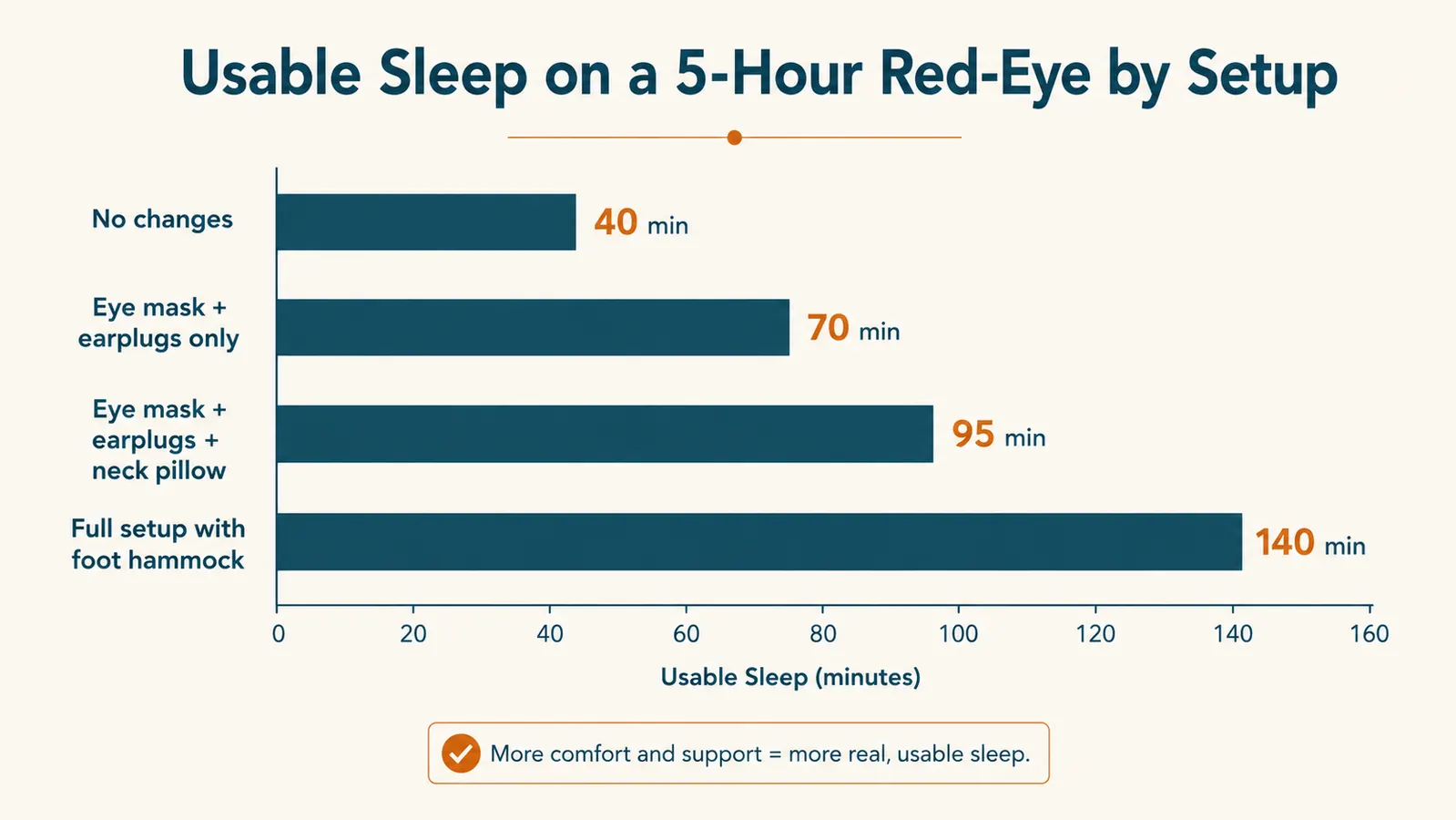
For a while I tried to sleep whenever I felt tired on a flight, which on a red-eye out of Boise meant I'd doze for twenty minutes here and there and never get anything that felt restful. What worked better was picking a specific window based on the flight length and arrival time, and treating that window as non-negotiable. On an overnight flight, I decide before boarding roughly when I want to be asleep by and when I want to be up and functional, based on what time we land, not what time it is back home.
Once I have that window, everything else lines up around it: the eye mask and earplugs go on right before the window starts, the foot hammock gets set up then too, and I skip caffeine and anything heavy to eat during that stretch. On a flight to the East Coast, that might mean I'm "asleep" from an hour after takeoff until ninety minutes before landing, regardless of what time zone my body thinks it is. It's not complicated, but deciding on the window ahead of time instead of improvising it mid-flight has made the biggest difference in how rested I actually feel getting off the plane. I also try to shift my bedtime by thirty or sixty minutes at home for a night or two before a big time-zone jump, which isn't a dramatic change but seems to make that first in-flight sleep window easier to actually fall into rather than just lie there waiting for.
Step 5: Get Up and Move Before You Settle In, and Again If You Wake Up
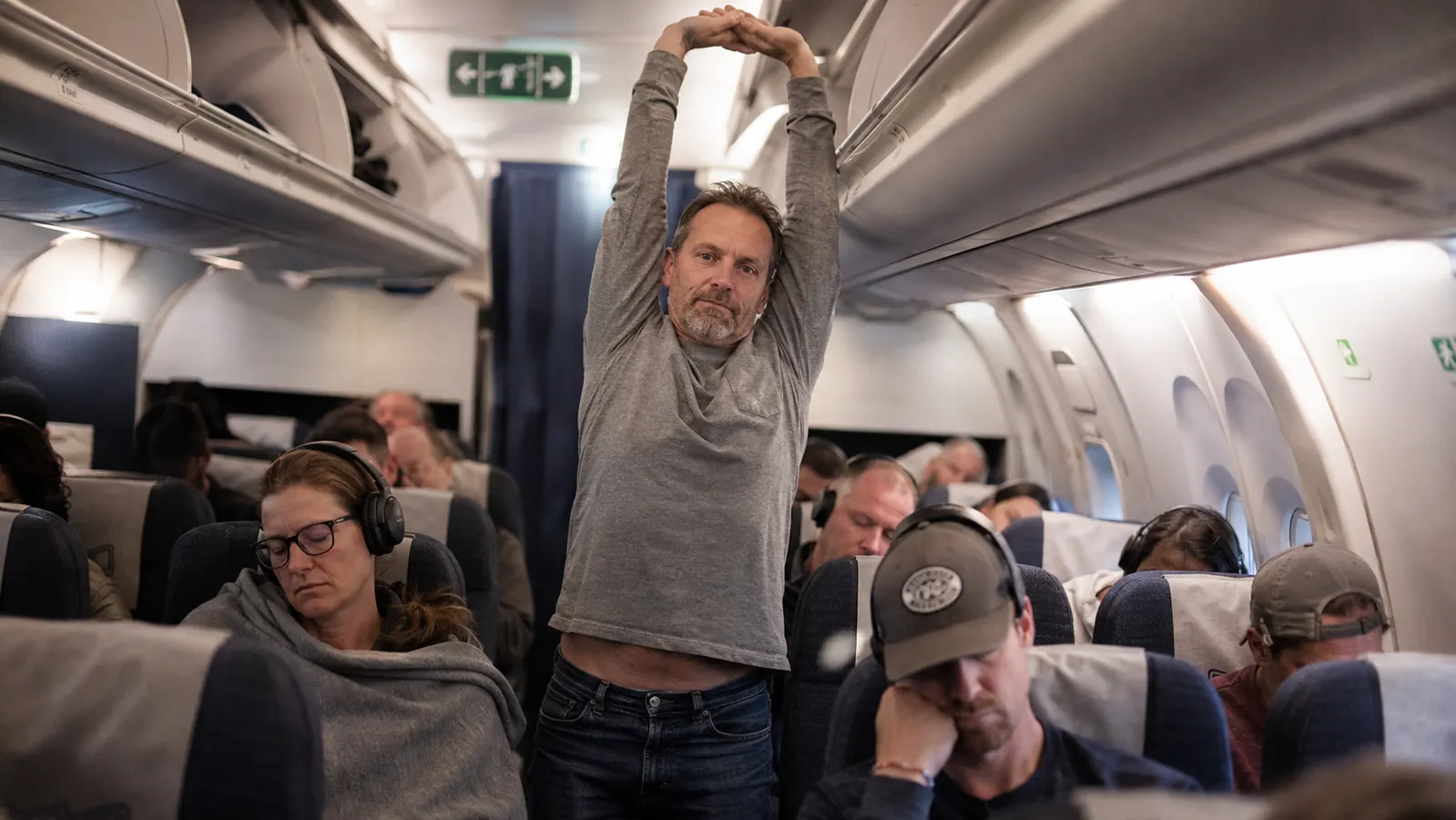
Before I start my sleep window, I make a point of walking to the back of the plane and back once, or at least standing and stretching in the aisle if the seatbelt sign allows it. It's a habit Rennie actually got me into, since she flat out won't sit still for a five-hour flight without moving at some point. Moving around the cabin periodically when it's safe to do so just makes settling in afterward feel more deliberate, like you've earned the rest instead of just collapsing into the seat.
If I wake up partway through, which happens on almost every long flight no matter how good the setup is, I don't just lie there frustrated. I'll get up again if the aisle is clear and the seatbelt sign is off, stretch for a minute, have a few sips of water, and then go back to the same setup, mask, earplugs, feet back in the hammock. That reset has saved more flights for me than any single piece of gear, because the second half of a long flight is where I used to fall apart the most.
What Else Helps
A few smaller things round out the system without being the main event. I drink more water than feels necessary in the terminal and again once we're at cruising altitude, since cabin air is dry and being dehydrated makes everything from headaches to general discomfort worse. I dress in layers, since cabin temperature swings more than you'd expect between boarding and landing, and I've had flights where I was sweating at the gate and cold an hour later. Some travelers use compression socks for general leg comfort on longer flights, and if that's something you're considering, especially with any history of circulation concerns, that's a conversation for your doctor rather than something to decide based on a travel blog. A supportive travel pillow that keeps your neck from rolling forward once you doze off also matters more than people expect, and pairs well with everything above. I also keep noise-canceling headphones charged before I board, since I've shown up at a gate more than once with dead batteries and regretted it for the whole flight, and I pack the whole kit, mask, plugs, pillow, and foot hammock, in one pouch so I'm not digging through a full carry-on once the cabin lights go down.
The foot hammock didn't make the seat any bigger. It just gave my knees somewhere to be, and it turned out that was most of the problem the whole time.
Your knees have been doing the work your seat should be doing. Give them somewhere to rest.
If you fly economy more than once or twice a year, the Angemay Foot Rest is the cheapest fix I've found for the part of long flights that actually wrecks you: nowhere for your legs to go. It packs flat, straps on in under a minute, and it's the first thing that goes in my bag before a long flight now.
Amazon Check Today's Price on Amazon →