
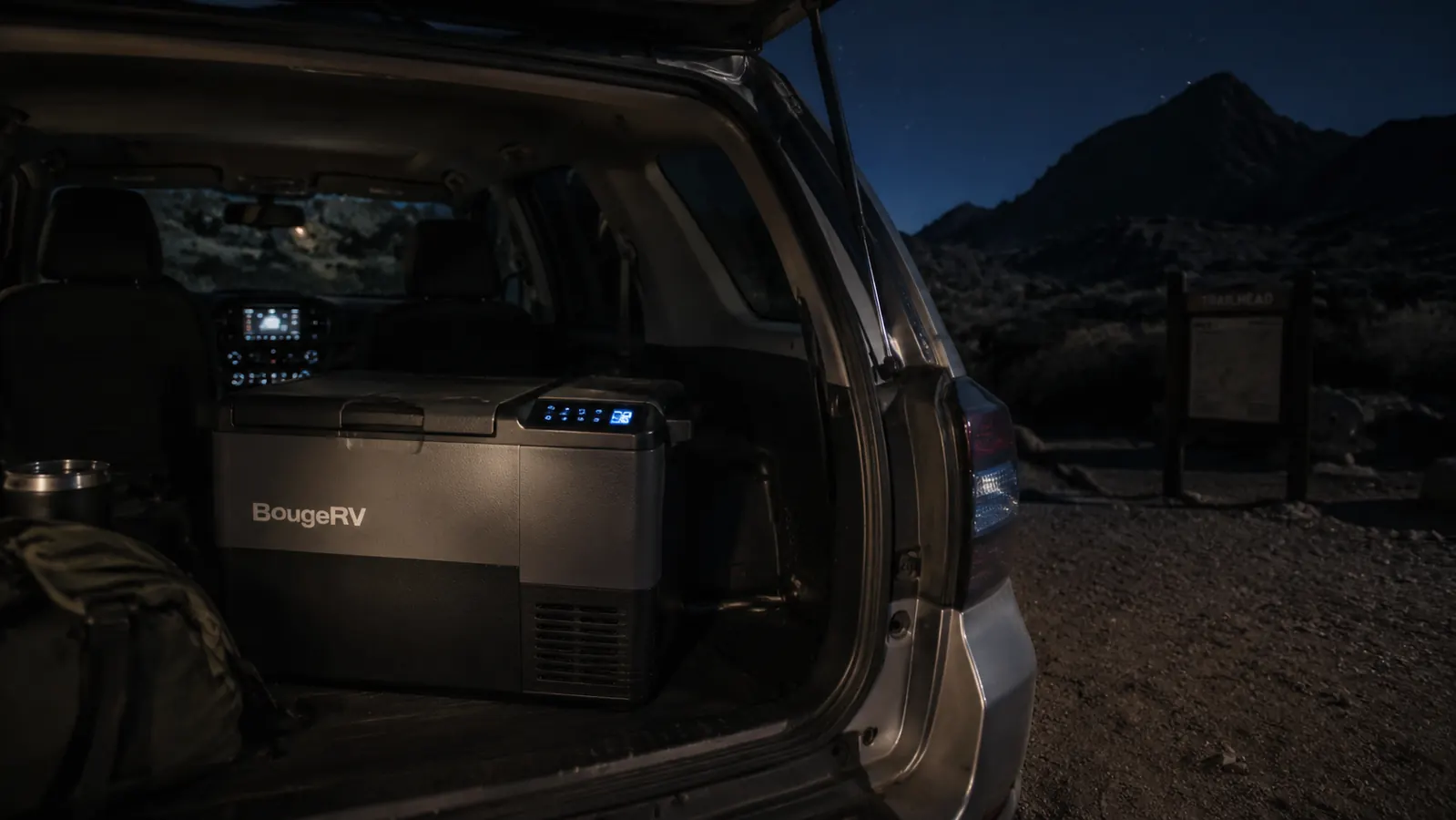
Every review of the BougeRV 23-quart 12V fridge I read before buying one talked about how fast it cools and how good it looks strapped into a rig at a scenic overlook. Almost none of them mentioned what happens at hour fourteen of a cold night with the engine off, or what it sounds like when the compressor kicks on at 2 a.m. in a quiet campsite, or that the 23 quarts on the box is not really 23 quarts once you account for the machinery living inside the case. I have run this fridge in the back of my 2018 4Runner for months of real trips with my wife Rennie, and this is the review I wish someone had written before I plugged it into my truck for the first time. It is not a takedown. I still use the fridge and still recommend it. But there are things about owning a compressor fridge that only show up once you have lived with one, and I would rather tell you now than let you find out the way I did.
The short version is that this is a genuinely capable piece of gear that comes with a genuine set of tradeoffs most sales copy skips over entirely. If you want the plain long-term performance rundown, I already wrote that one, and this piece is deliberately not a repeat of it. This is the version that leads with what nobody tells you, and stays there.
The Quick Verdict
A solid compressor fridge that will strand your truck's battery if you don't plan for it, cycles loud enough to notice at night, and holds less than the rated 23 quarts once you account for the compressor housing.
Amazon Check Today's Price →Before You Buy a 12V Fridge, Know What You're Actually Signing Up For
This is the fridge I still use, but only after learning the hard way what it takes to run one without waking up to a dead truck.
Amazon Check Today's Price on Amazon →How I've Used It, and Why This Review Exists
This fridge rides strapped into the cargo area behind the folded rear seats of the 4Runner on every trip Rennie and I take, and it also gets duty as a stationary fridge in the garage between trips. I have used it in Boise winters, on gravel roads well above 100 degrees, and on multi-day stretches where the nearest grocery store was a two-hour detour. None of that is unusual for gear in this category. What is unusual, at least compared to most of what gets written about this fridge, is that I kept a running log of the things that annoyed me, surprised me, or cost me money and time to work around. This piece is that log, organized.
I want to be clear about the tone here before I get into the specifics. I am not trying to talk you out of buying this fridge. I bought it, I kept it, and I would buy it again knowing everything I know now. But knowing everything I know now would have changed how I set it up from day one, and that is the value I'm trying to hand you before you spend anything.
The Battery Math Nobody Puts on the Box
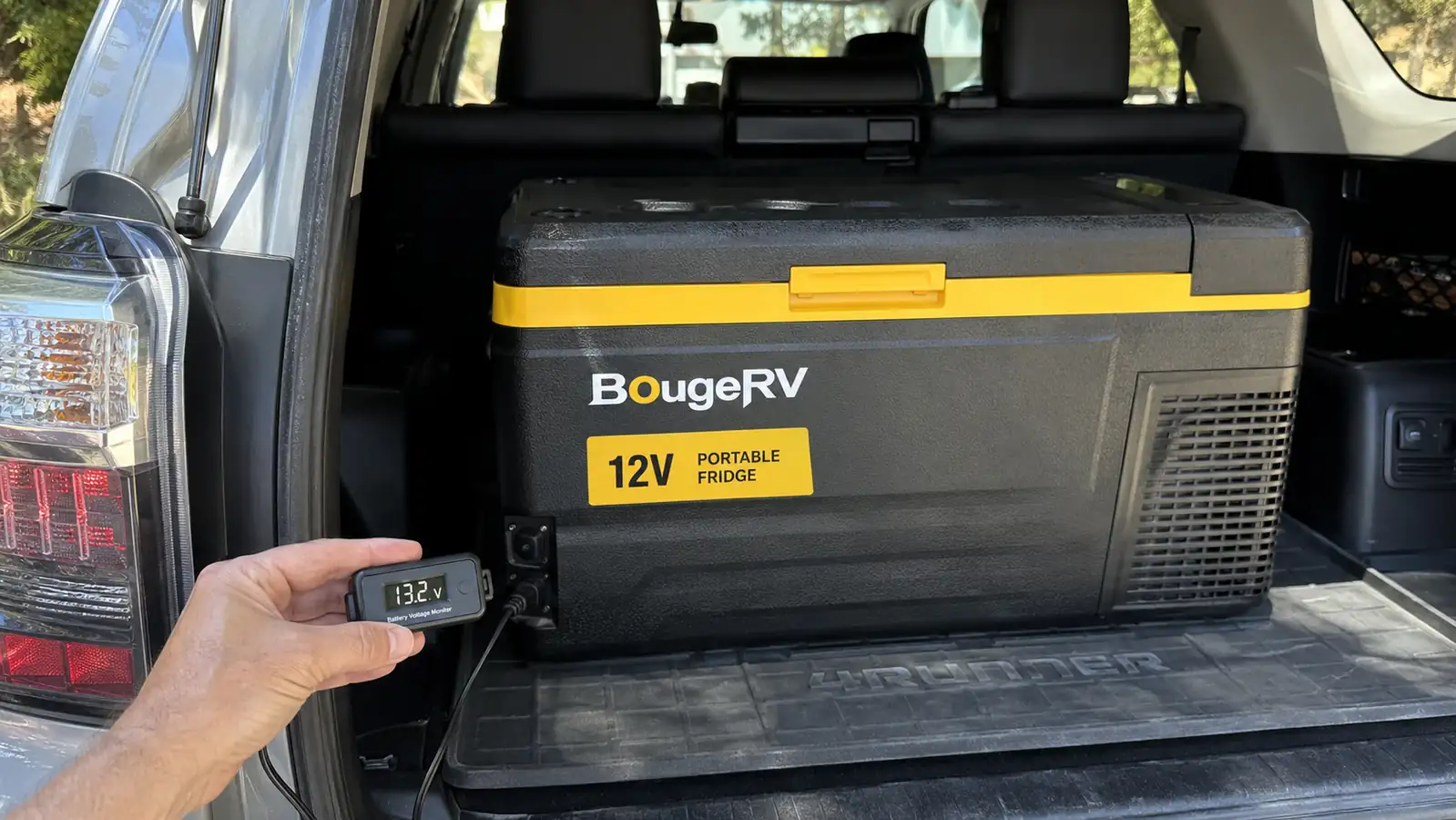
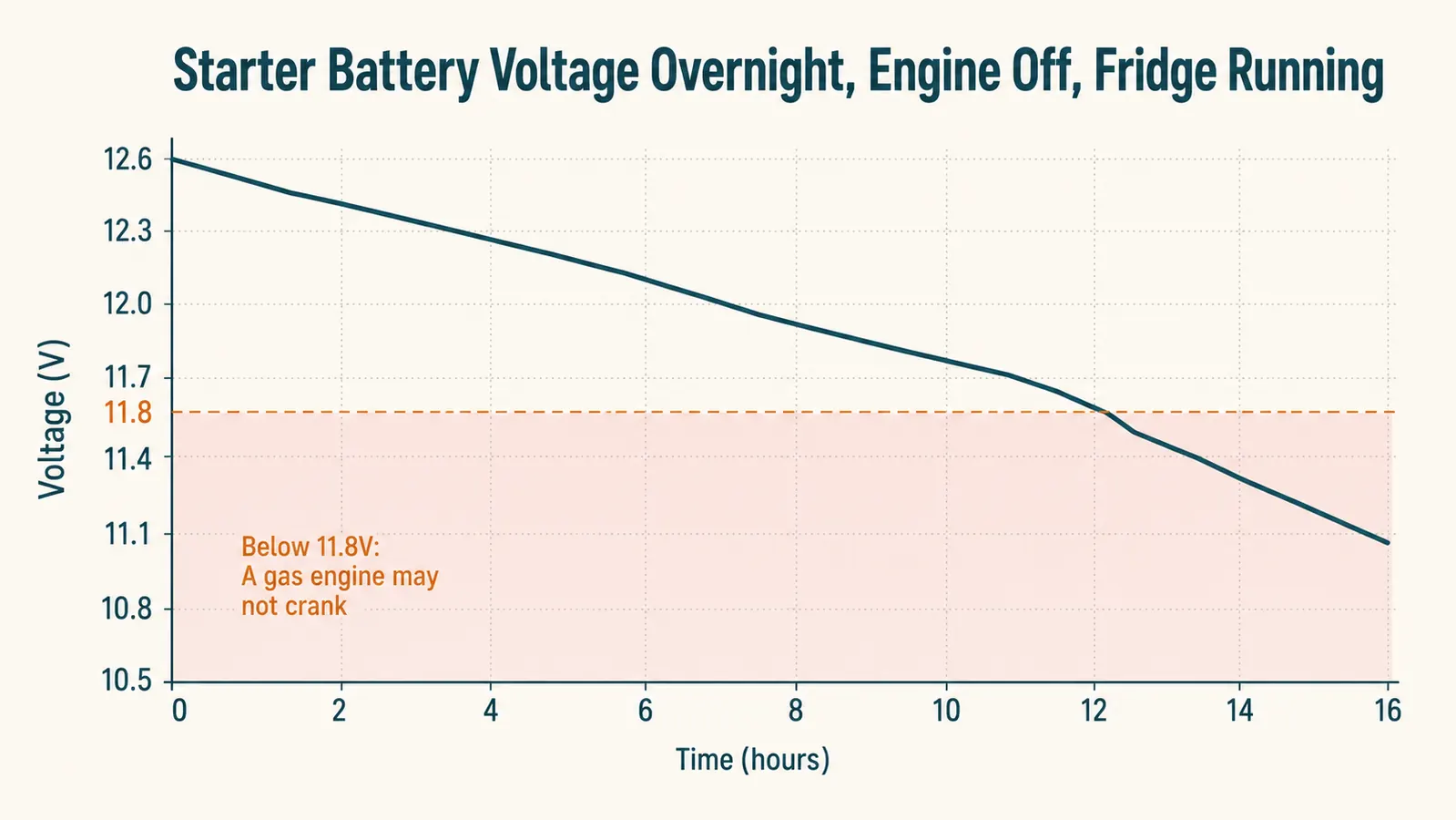
A compressor fridge is not a cooler. It draws real, continuous power the entire time it is on, and the number that matters is not the peak wattage on the spec sheet, it is the average draw over a full day of cycling. On startup this unit pulls close to 60 watts, then settles into a cycle that lands somewhere between 30 and 45 watts depending on how hot it is outside and how often the lid gets opened. Do the arithmetic on a stock vehicle starter battery, which typically holds somewhere around 45 to 50 amp-hours of usable capacity before you risk not being able to crank the engine, and you land on a window of roughly 10 to 14 hours before that battery is in dangerous territory with the engine off. I did not do this math before my first overnight trip. I found it out the hard way instead.
The specific version of finding it out involved a gravel pullout near the Sawtooths, a fridge plugged straight into the 4Runner's cigarette lighter socket with no isolator between it and the starter battery, and roughly 13 hours parked overnight with the engine off. In the morning the fridge was still holding 34 degrees, doing exactly what it was built to do. The truck would not turn over. I ended up flagging down another camper for a jump, which cost me nothing but pride and about forty-five minutes, but it is the kind of morning that changes how you think about a piece of gear you bought to make road trips easier, not harder. The fridge did not fail. My setup did. That distinction matters, and it is the one thing most reviews of this product skip entirely, because most reviewers are testing it for a weekend, not living with it.
The fix is not complicated but it is not optional either. You need a dual-battery setup with an isolator, a dedicated deep-cycle battery, or a portable power station rated for at least a full day's draw if you plan to run this fridge unattended overnight with the engine off. Budget for that as part of the purchase, not as an accessory you might get around to later. The fridge does have a low-voltage cutoff that will shut it down before it does permanent damage to a battery, and that feature has saved me since, but by the time it trips you have already lost your groceries and possibly your ability to start the truck. It is a last line of defense, not a plan.
What It Actually Sounds Like at Night
The decibel rating on paper sounds quiet, and in a moving vehicle with road noise and wind, it genuinely is quiet enough to ignore. What the spec sheet does not capture is the pattern of the noise once you are parked somewhere silent and trying to sleep. The compressor does not run continuously. It cycles on, runs for a stretch, shuts off, sits silent for a while, then kicks back on, and that on-off rhythm is far more noticeable to a sleeping brain than a steady hum would be. I have woken up more than once to the compressor kicking back on in the middle of the night, not because it is loud in absolute terms, but because the sudden change from silence to a low mechanical hum is the kind of thing your ear catches even through sleep. On a warmer night, when the compressor is working harder and cycling more frequently, this happens more, not less.
None of this has been a dealbreaker for us. We sleep in the truck bed on some trips and in a tent on others, and either way we have adjusted rather than suffered. But if you are a genuinely light sleeper, or you plan to keep the fridge inside a tent or a rooftop tent rather than in the vehicle overnight, know that this is a machine with moving parts, and moving parts make noise on a schedule you do not control.
23 Quarts Sounds Bigger Than It Is
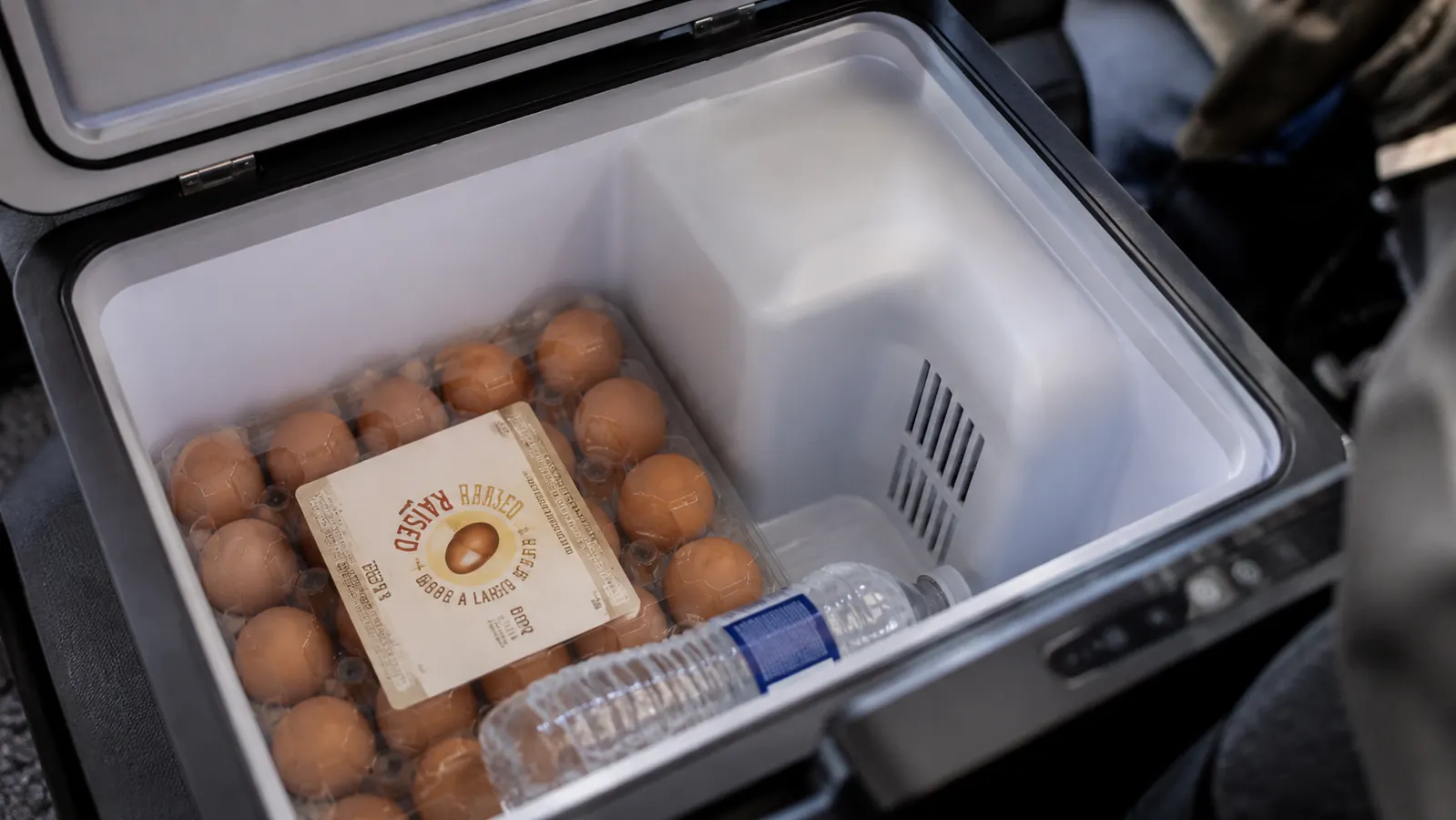
This is the detail that surprised me most after unboxing, and it is almost never mentioned in reviews written from a spec sheet instead of a loaded fridge. The 23-quart rating describes the interior volume of the case, but the compressor and its housing live inside that same compartment, taking up a raised block in one back corner that does not go away no matter how you pack around it. Once you account for that housing, plus the shape of the curved interior walls that don't hold square items as efficiently as a straight-sided cooler would, the usable space feels closer to somewhere in the high teens for anything with real shape to it, like a gallon jug of milk or a rectangular meal-prep container. Cans and bottles pack around the housing fine. Bulkier, awkwardly shaped groceries do not, and you will find yourself rearranging things more than once to make everything fit.
This is not a defect. Every compressor fridge in this size class has to put the compressor somewhere, and BougeRV is not hiding the dimensions. But the number on the box invites a comparison to a 23-quart hard cooler that is not quite fair, since a cooler has no internal hardware eating into its space. If you are packing for two people on a week-long trip, plan your loadout around roughly four-fifths of the rated capacity, not the full number, and you will not be surprised at the trailhead.
It Works Great in Heat, But It Works Harder Than the Marketing Suggests
I have driven this fridge through triple-digit ambient heat on gravel roads outside Moab and it held its set temperature the entire time, which is a genuinely good result. What the marketing does not spell out is what that performance costs. On a hot day the compressor runs close to constantly rather than cycling on and off, which means the power draw I described earlier sits closer to the high end of the range for the entire drive, and the noise pattern shifts from occasional cycling to something closer to a steady hum. The fridge is doing its job, but it is working at or near its limit to do it, and that has two practical consequences. First, your battery math above gets worse in hot weather, not better, so plan your power setup around your hottest trip, not your average one. Second, running a compressor at its limit for hours at a stretch is exactly the kind of use that wears a mechanical part down faster over time, which is part of why I still check the fridge's latches and gasket before every long, hot drive rather than assuming nothing has changed.
What Happens When the Power Actually Runs Out
This is the scenario nobody writes about, because it requires living with the fridge long enough for it to happen, and it happened to me once on a trip where I had not yet installed a proper isolator setup. The fridge's low-voltage cutoff tripped sometime overnight and shut the compressor down to protect the battery, which is exactly what it is supposed to do. What I found in the morning was a fridge that had drifted up from 34 degrees to somewhere in the mid-40s over roughly six hours without power, still cool to the touch but no longer cold enough that I trusted the dairy or the raw chicken inside it. I ended up tossing about fifteen dollars of groceries rather than gamble on food safety, which stings, but it is the right call every time. A compressor fridge with no backup power is not meaningfully different from a cooler with melted ice once the compressor stops running, and it will not tell you food has gone bad. It only tells you the temperature has drifted. What you do with that information is on you.
The lesson I took from that morning was not to distrust the fridge. It performed exactly as designed. The lesson was to never again let it run unattended overnight without a battery setup that can actually cover the hours involved, and to keep a cheap probe thermometer in the door pocket so I am checking an actual number instead of guessing by touch. If you are weighing this fridge against a simpler option that does not carry this particular failure mode, our side-by-side comparison against a standard cooler box walks through that tradeoff directly.
What I Liked
- Holds its set temperature through genuinely hot, hard driving conditions
- Low-voltage cutoff protects your battery once it trips, even if it costs you the groceries
- Digital readout has matched a separate probe thermometer every time I've checked it
- Wheels and retractable handle hold up well to gravel and dirt
- Freezer mode down to negative 8 degrees is a genuine second function, not a gimmick
Where It Falls Short
- Will strand a stock starter battery in roughly 10 to 14 hours with the engine off and no isolator
- Compressor cycling is noticeable enough to interrupt light sleepers overnight
- Real usable capacity runs closer to four-fifths of the 23-quart rating once you pack around the compressor housing
- Runs at or near its limit in triple-digit heat, which increases both noise and power draw
- Gives you no warning when contents have drifted into an unsafe temperature range, only a number
The fridge did not fail that morning near the Sawtooths. My setup did. That's the distinction most reviews skip.
Who This Is For
This fridge makes the most sense for someone who is willing to treat it as a small electrical project, not just a purchase. If you are already comfortable wiring in an isolator and a second battery, or you already own a portable power station with enough capacity to cover a full day's draw, the tradeoffs above are manageable and the fridge earns its keep. It is also a good fit if your trips run long enough that a cooler full of melting ice was never going to cut it anyway, since the alternative you are actually comparing against has its own real downsides. For a broader look at why people move to a 12V fridge at all, our piece on what actually pushed us to make the switch covers the decision from the other direction.
Who Should Skip It
Skip this if you are not willing to add a battery isolator, a second battery, or a power station to your setup, because running it straight off a stock starter battery overnight is a real and repeatable way to end up stranded. Skip it too if you are a genuinely light sleeper who plans to keep the fridge inside a tent or a small cab where the compressor cycling will be close to your head all night. And skip it if you are packing for more than two people on a long trip, since the real usable space is smaller than the number on the box suggests, and you will run out of room faster than the spec sheet implies.
Know the Tradeoffs Going In, and It's a Fridge Worth Owning
This is not a perfect product, but it is an honest one once you know what to plan for. Build the battery setup around it first, and it will do exactly what it promises.
Amazon Check Today's Price on Amazon →